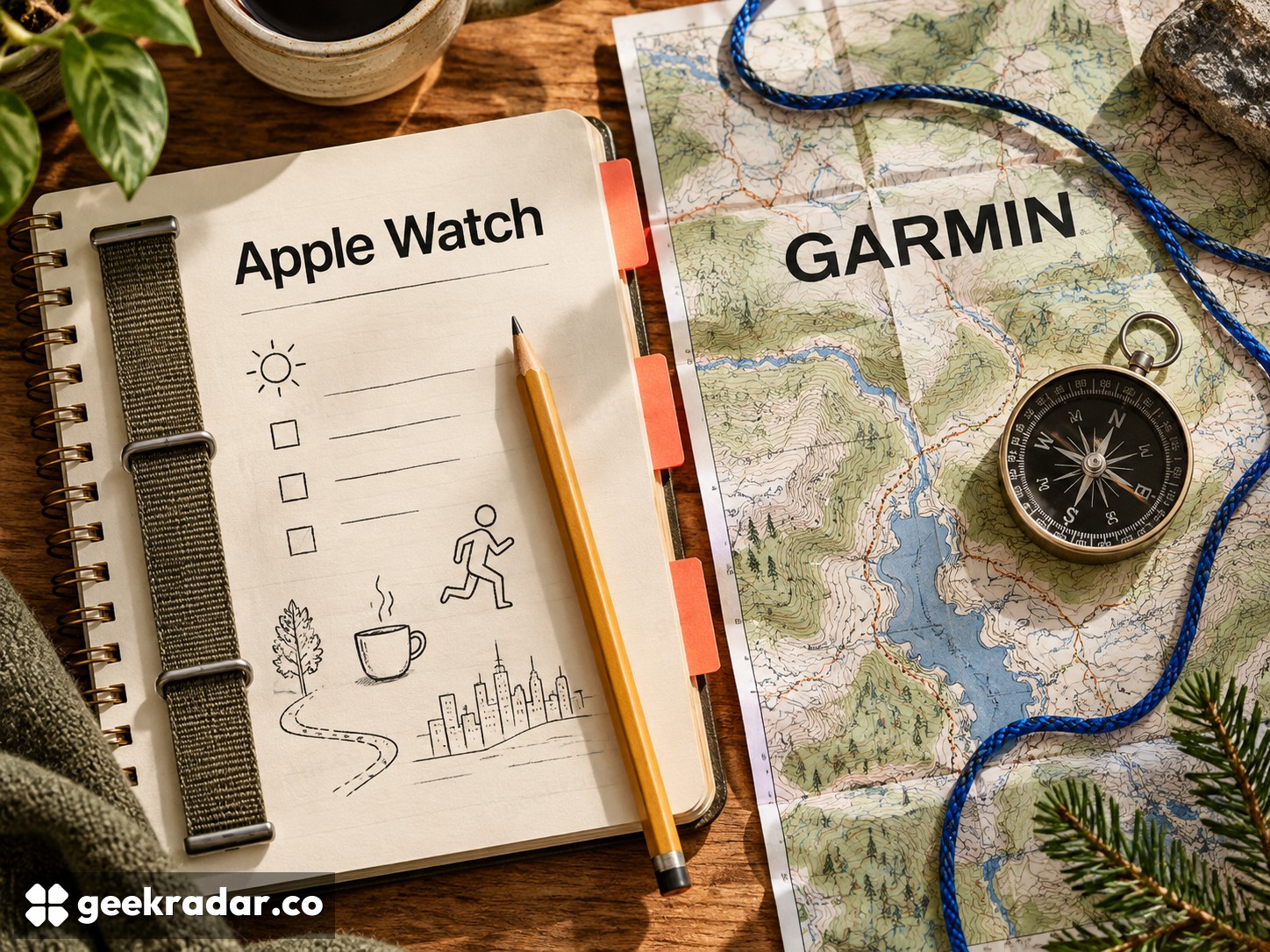
Apple Watch vs Garmin: everyday companion or training-centered watch?
The strongest choice depends on phone compatibility, charging habits and the training features you use. Garmin and Apple Watch each contain very different tiers.
Apple Watch makes its strongest case as an extension of an iPhone that also tracks activity. Garmin makes its strongest case as a collection of training and outdoor tools that also handle everyday smartwatch tasks. There is substantial overlap, but those starting points help explain why a person can prefer one family without claiming the other is worse at everything.
The first filter is the phone. Apple's comparison page specifies compatible iPhones and software for each current watch. An Android owner should not treat Apple Watch as an ordinary cross-platform accessory. Even with an iPhone, check compatibility before buying an older watch or replacing the phone.
Apple Watch: the everyday companion
The family spans different budgets and physical priorities through SE, Series and Ultra. The attraction is a common watchOS foundation with messaging, applications and activity features close to the phone experience. Its advantage is breadth within a familiar routine: a short interaction on the wrist can save taking out the phone repeatedly.
Its disadvantage is that the phone relationship is part of the commitment. Someone considering a future switch away from iPhone should include the watch in that decision. Cellular capability also needs separate checking: the presence of a cellular model does not establish support from your carrier or eliminate all setup requirements.
Battery comparisons need care even within Apple Watch. Apple's own table gives different endurance claims for different tiers, with detailed test conditions. Treat an Ultra's figures as an Ultra claim, not a statement about every Apple Watch. The useful question is whether charging fits your day while leaving the watch available for the activities you want to record.
Garmin: choose a discipline, then a range
Garmin's description of its product families separates running-focused Forerunner, everyday smartwatch lines such as Venu and vívoactive, and outdoor families including fēnix and Instinct. Mapping, music, communication and other features vary by model. Garmin Connect brings activity records together; Connect+ adds optional paid capabilities.
That structure is useful for someone whose requirements begin with a sport or a route. The same breadth can make shopping harder. A rugged-looking case does not establish that detailed maps are included, and a Garmin badge does not establish identical training tools throughout the range. Buying the most expensive outdoor model is unnecessary if the missing feature is simply a running workout you could get lower down.
Garmin's training proposition is more specific than a large list of activity icons. Garmin Coach offers plans through Connect for supported devices and activities. Check the actual plan and watch combination. A structured plan you will follow is more useful than a dashboard you never reopen.
Where each family earns its price
| Priority | Apple Watch | Garmin |
|---|---|---|
| Frequent phone-related tasks | A natural starting point for compatible iPhone owners | Check the desired phone interaction and its platform limits |
| A specific sport or outdoor requirement | Check applications and the chosen watch tier | Several specialised families to shortlist |
| Charging routine | Compare the exact tier and usage mode | Compare the exact watch, display and GPS mode |
| Main compromise | Commitment to the iPhone relationship | A more complex catalogue with significant feature differences |
This is a map of the decision, not a sensor-accuracy ranking. Neither company's feature list establishes which device measures your particular activity more accurately. Health-related features also have regional and model restrictions; their presence in a US presentation does not establish Italian availability.
Buy for the week you actually have
Write down a normal week before shopping: workdays, workouts, sleep tracking, long outings and the times when a charger is convenient. Add the applications, payments and phone interactions you genuinely use. Then mark the features that would justify changing your routine, rather than assuming you will adopt every capability after buying.
Apple Watch is the stronger starting point when the wrist should simplify an existing iPhone-centred day. Garmin is the stronger starting point when a defined training or outdoor need should organise the purchase. For Italian buyers, verify local payment support, connected services and subscriptions before counting them as benefits. A watch earns its price by being on your wrist when needed, not by collecting the most impressive unused modes.