Rockstar’s “GTA 5.5” comment explains GTA VI’s scope, not its verdict
A quicker sequel was an alternative the studio says it rejected. The useful question is how ambition becomes a coherent world for the player.
In this guide
Rockstar’s explanation for GTA VI’s long development is a choice about scope: a closer continuation of GTA V could have arrived sooner, but the studio wanted a larger departure. In The Guardian’s November 15 interview, publishing executive Jennifer Kolbe says the team could have made “GTA 5.5” more quickly.
The remark clarifies an ambition. It does not prove that every additional year improved the finished game, or give players a way to calculate what a smaller sequel would have contained. There is no released alternative against which to measure that decision.
A sequel can change its world without changing its address
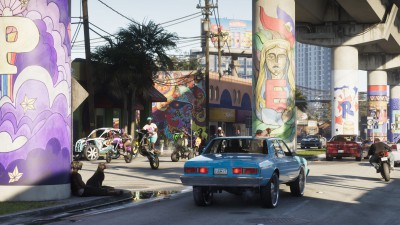
The useful question is what the added scope lets a player do or understand. Rockstar’s official presentation centers the game on Jason and Lucia, with a story extending across Leonida. Its people-and-places material establishes contrasting communities and ambitions within that state.
Those choices create several kinds of work at once. A setting needs places to visit, but it also needs reasons for those places to exist in relation to one another. A character’s work, transport and social connections can make a city intelligible in a way that another block of buildings cannot.
Consider two streets with the same amount of visible detail. If one connects a character’s home, workplace and social life, returning to it can acquire meaning. If the other merely holds unrelated activities, its extra objects may offer less to remember. That is a design distinction, not a claim that we have tested either outcome in GTA VI.
The launch material makes it reasonable to ask how the new setting and protagonists connect. It does not yet establish that every system will fit together equally well.

More work creates more relationships to maintain
A larger production does not simply add independent features. Once two systems meet, someone has to decide what happens at their boundary. A scene that works while a player walks may need a different response when that player arrives in a vehicle. A convincing street can lose that quality if the people on it respond inconsistently.
That is why the “5.5” shorthand is interesting beyond the joke. The alternative is not necessarily the same game with fewer decorative objects. A narrower scope can reduce the number of interactions that need to be authored, integrated and checked. A more ambitious scope accepts that additional coordination in pursuit of experiences a simpler project might not support.
None of that lets an outside observer assign a verified cost to an individual feature. Nor should a developer’s explanation turn into an excuse to dismiss criticism of the result. The player buys the finished experience, not the difficulty of making it.
The calendar is context, not the verdict
Our earlier coverage of Rockstar’s emphasis on empathy examines one announced creative direction. The development comment is a separate point: Rockstar chose to spend its opportunity on a more substantial change rather than a quicker iteration.
For players, the payoff must appear in ordinary minutes, not only in a spectacular trailer. A place worth revisiting, a choice with an intelligible consequence or a relationship that gives an action weight would be more persuasive than the number of years on a production timeline.
The length of the wait explains the pressure surrounding GTA VI. It cannot be its strongest recommendation. That must come from what the game gives back once the waiting ends.