Lenovo’s SC755 V5 makes 96 CPUs a choice between different kinds of nodes
The liquid-cooled tray supports two dual-socket or four single-socket nodes, with configuration limits that matter.
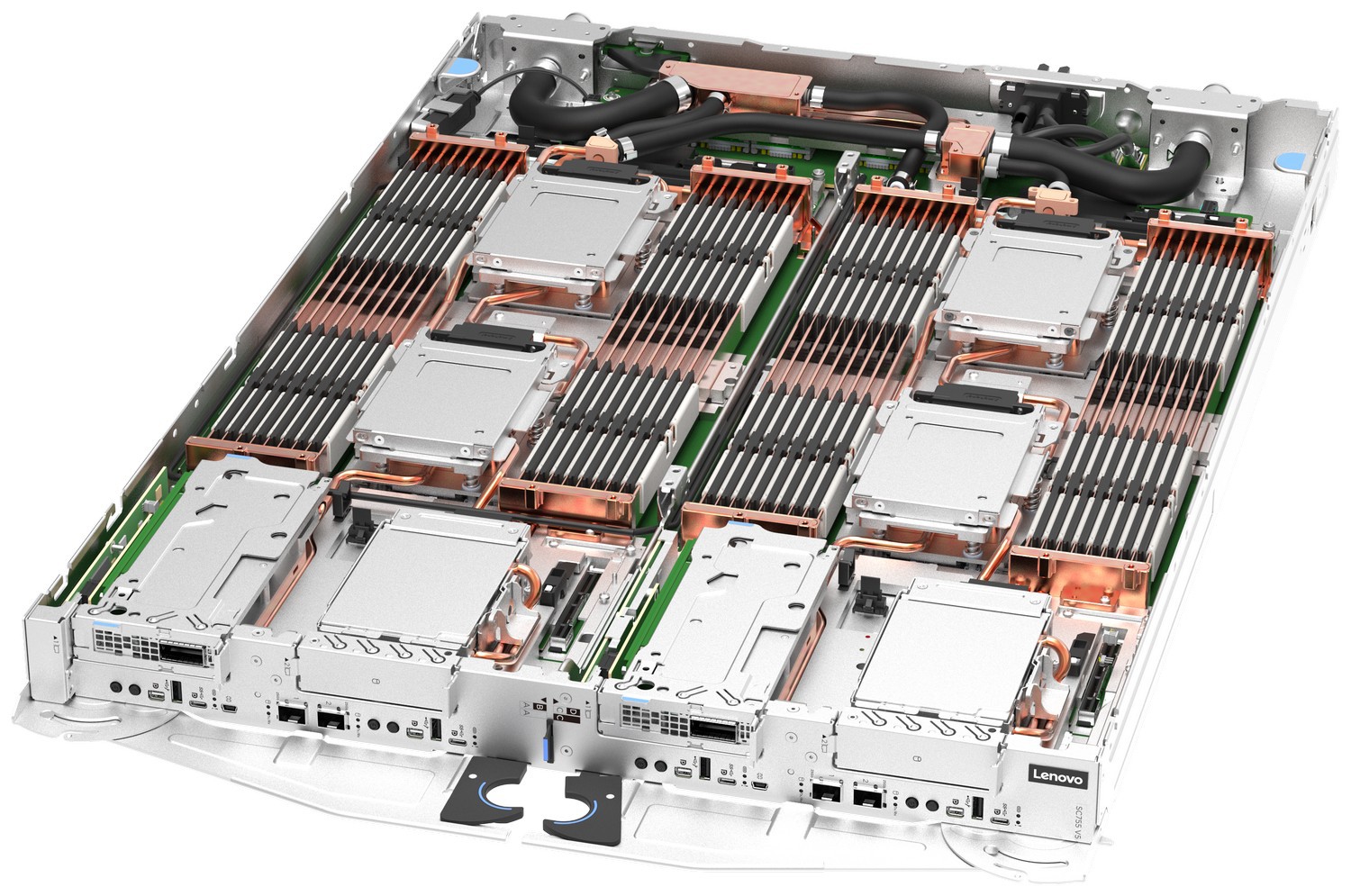
Lenovo’s ThinkSystem SC755 V5 packs four AMD EPYC 9006 processors into a liquid-cooled tray, but the more interesting choice is how those processors are divided. The product guide supports either two dual-socket nodes or four single-socket nodes. The same physical density can therefore serve fewer, larger machines or a greater number of independently configured systems.
That distinction is easy to lose in a headline about a rack containing 96 CPUs. A CPU count is not automatically a node count, and a maximum core count is not a measured application result. The SC755 V5 is infrastructure whose usefulness depends on how software, memory and cooling are arranged around those processors.
Two large nodes or four smaller ones
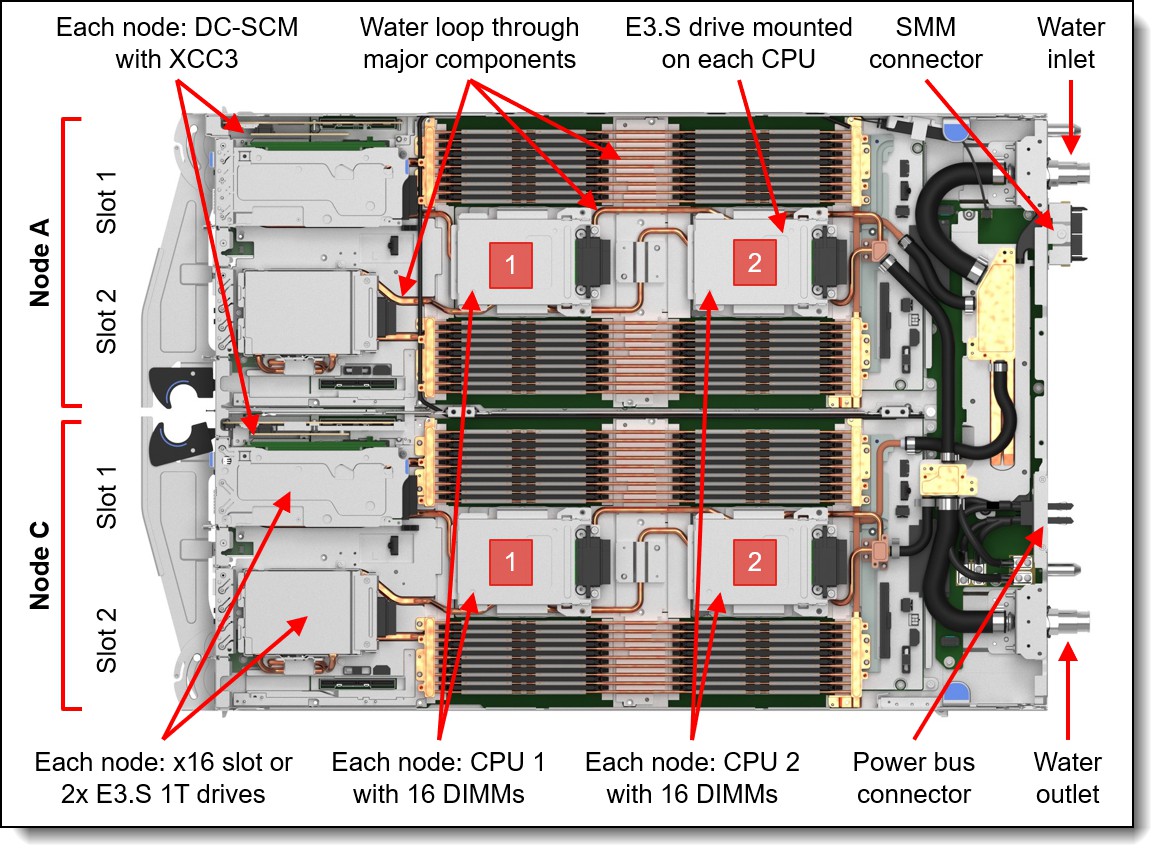
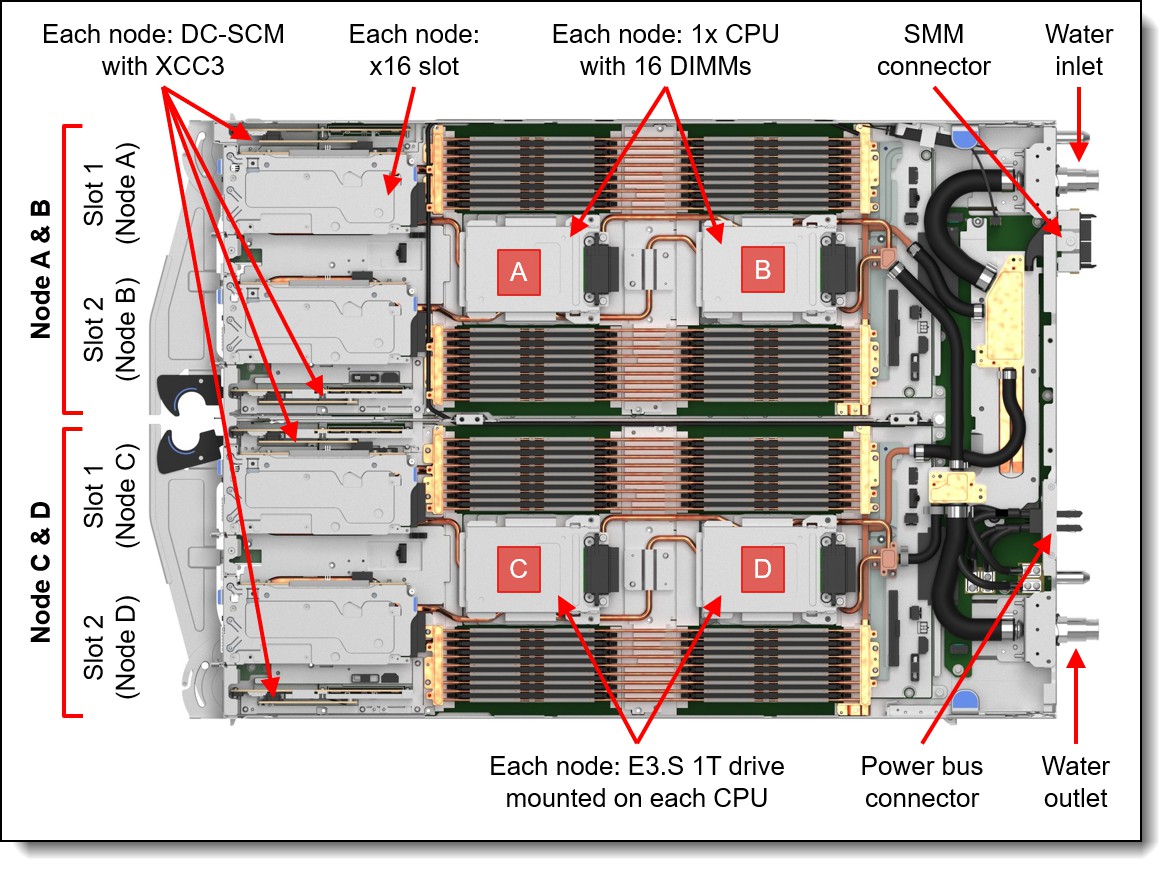
With eight trays in a 13U N1380 enclosure and three enclosures in the described rack configuration, Lenovo reaches 96 processors. That corresponds to 48 dual-socket nodes or 96 single-socket nodes. At the family’s maximum 256 cores per processor, the arithmetic reaches 24,576 physical cores; it does not imply every configuration ships with that processor option.
Dual-socket nodes can keep a larger workload inside one operating-system instance, with access to both processors and their attached memory. Single-socket nodes create more separate instances and avoid requiring a workload to span two sockets. Which is preferable depends on the application’s communication pattern, licensing and scheduling, rather than one topology being universally faster.
The guide describes platform configuration choices. It does not establish that an administrator can turn a running dual-socket job into two independent machines without stopping it. That would be a different capability, requiring its own evidence.
Warm water carries most of the heat away
Lenovo specifies inlet water temperatures up to 45°C. Its more precise heat-capture figure is 95% under the stated condition of 45°C water and 30°C room air. That is a useful qualification to broad descriptions of direct liquid cooling: the installation still has to account for heat not carried away by the liquid circuit.
Warmer facility water can reduce dependence on very cold cooling loops, but the server specification alone cannot establish the energy savings of a whole data centre. Pumps, heat exchangers, outdoor conditions and the existing plant determine the outcome. Lenovo’s energy claims remain vendor claims, not an independent measurement of a particular deployment.
This makes the cooling interface part of the purchasing decision. A dense tray does not become a practical installation simply because it fits in a rack; the facility must deliver the flow and temperature range its sustained load requires.
Maximum specifications do not all coexist
The guide’s storage and expansion options also need to be read as configurations. Front PCIe expansion and some E3.S drive arrangements compete for space. Adding the largest values from separate options would describe a machine that the documented layout does not necessarily support.
Memory follows the processor topology too. The platform provides sixteen channels per processor, but populated capacity, DIMM type and supported speed depend on the selected arrangement. The largest memory figure and the fastest listed memory figure should not be combined without checking the actual supported bill of materials.
The SC755 V5’s density is impressive as an engineering arrangement. Its practical advantage is the ability to choose how that density is exposed to software, then cool it within a documented envelope. The rack’s headline number matters less than whether the application can keep its share of those cores busy.