Gigabyte AI TOP AERO puts shared memory ahead of a simple GPU comparison
Up to 128GB in a roughly one-litre desktop changes what can fit locally, without establishing how fast every model runs.
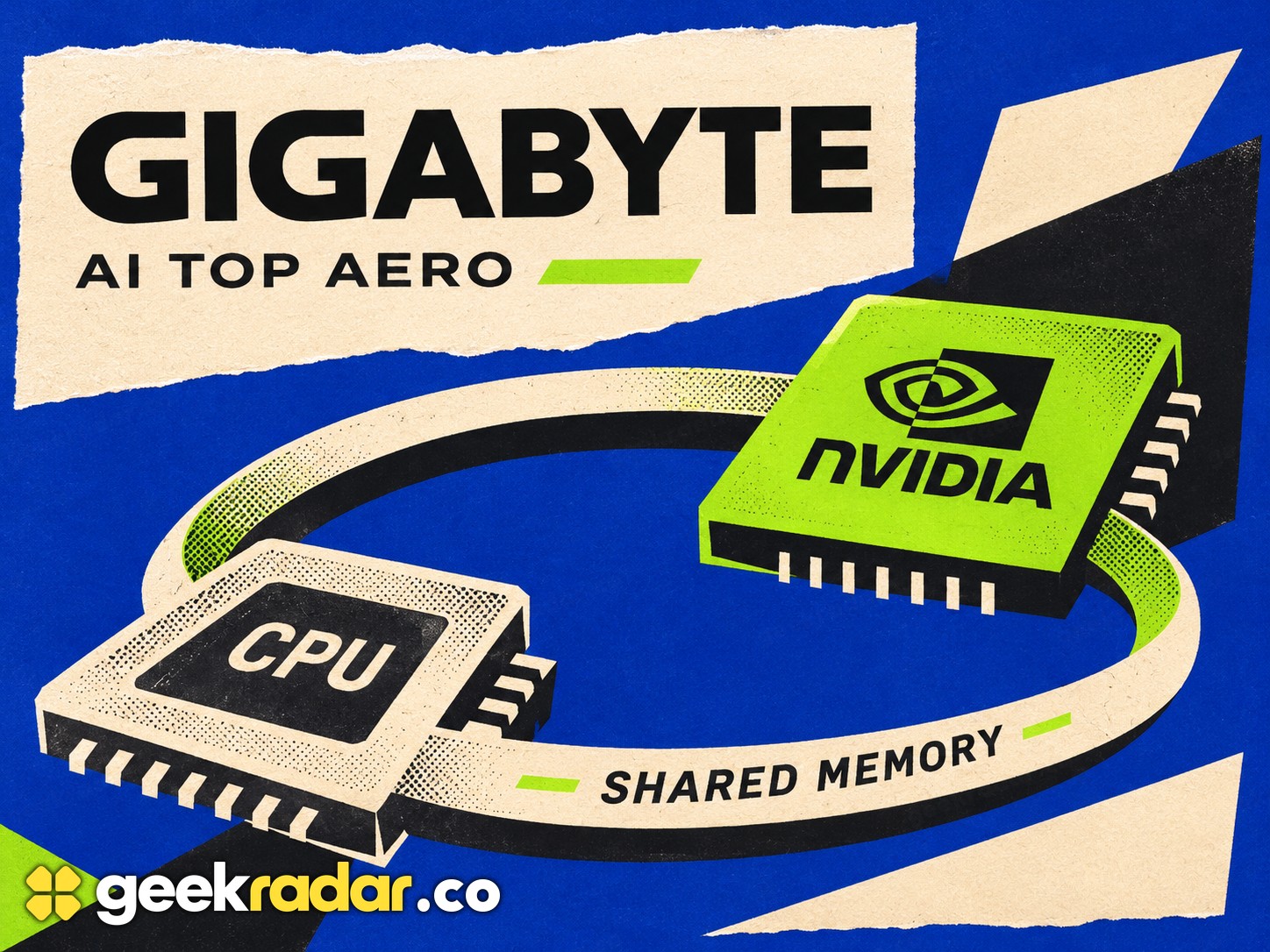
Gigabyte’s AI TOP AERO puts a large shared-memory pool into a desktop of roughly one litre. Its launch announcement specifies NVIDIA’s RTX Spark N1X platform, a 20-core Grace CPU and Blackwell RTX graphics, with configurations up to 128GB of LPDDR5x unified memory and a 4TB PCIe 5.0 SSD. The practical attraction is room for local AI workloads in a small system, not a demonstrated speed advantage over every discrete graphics card.
The AI TOP AERO runs Windows 11 and combines development, creative software and supported games in one machine. Gigabyte dates the launch to November 10, while its November 11 announcement leaves prices, configurations and availability to regional notices. A launch date without a regional price is not a worldwide retail offer.
Memory capacity answers only one part of the model question
A model must fit somewhere before it can run effectively. Shared memory gives CPU and GPU access to a common pool, avoiding the simple assumption that the GPU is limited to a separate graphics card’s dedicated capacity. But the advertised total also serves the operating system, applications and other active work. It is not a guarantee that all 128GB are free for model weights.
The running workload also needs more than weights. Context data, intermediate buffers and the software framework consume memory, while the precision or quantization chosen changes the size and sometimes the quality of the model. A parameter count without those conditions is a poor compatibility promise.
Capacity and speed are separate again. A larger model fitting locally does not tell us how quickly it produces an answer, how long a batch takes or how the machine behaves under simultaneous graphics work. Those require measurements of a specified model, software stack and workload. Gigabyte’s announcement does not provide an independent benchmark that settles those questions.
That is a different architecture from distributing a model across several computers, where network transfers remain part of the workload.
Local execution still has a software boundary
Gigabyte lists CUDA-compatible tools, supported Nemotron models, LM Studio and Ollama among the intended uses. Compatibility still belongs to the particular application and model build. Installing a familiar front end does not prove that every backend or extension uses the accelerator in the same way.
Running inference locally can keep that computation and its input on the machine. It does not automatically make an entire agent workflow offline: a connected tool, search provider or cloud fallback can still send information elsewhere. The useful privacy boundary is the actual configured path of the data.
The machine’s 10GbE, Wi-Fi 7 and USB-C connectivity also makes it plausible as a shared local resource. Network access introduces its own practical requirements, including authentication and limits on who can submit work. A small box serving several clients is still a service that needs to be managed.
The enclosure makes sustained work the real test
Gigabyte emphasizes its cooling design for long-running AI and creative tasks. In a compact enclosure, sustained throughput and noise are more revealing than a short burst. The same system may also be asked to run a game or creative application, competing for thermal and memory resources.
AI TOP AERO therefore presents a specific proposition: substantial shared capacity with a small desktop footprint. It could make a model that is awkward to host elsewhere more convenient to keep nearby. Whether it is the better machine depends on the time, noise and price attached to that convenience, none of which should be inferred from the memory figure alone.