Firefox Enterprise brings browser management in-house—and the responsibility with it
Mozilla’s first release combines a locally hosted console with device-side data controls. Early European sales focus does not yet establish an Italian commercial rollout.
Mozilla's new Firefox Enterprise offering puts the browser's management infrastructure inside the customer's environment. That is a more consequential distinction than another business-themed browser download: an organization can operate the console and supporting services that define how its fleet is managed.
The launch announcement on 12 October describes an initial European sales focus on France, Germany, Austria and Switzerland. The 158.0 release notes, dated 13 October, still direct organizations to request early access. An Italian organization should not read that as confirmation of a fully available Italian commercial rollout.
Self-hosting moves responsibility as well as control
The release notes describe an admin console and services including updates, synchronization, settings and telemetry running on the organization's infrastructure. That offers control over where operational data goes and which systems are involved. It also leaves the organization responsible for running that infrastructure reliably.
Those two consequences belong together. A centrally hosted service transfers some operational work to a supplier; a customer-operated deployment brings that work back inside the institution or its chosen hosting arrangement. Neither location automatically proves that a system is secure. The practical questions include who patches it, who can administer it and what happens when part of the management service becomes unavailable.
The distinction is particularly relevant to organizations evaluating technological dependency. They may want to retain their existing identity and monitoring systems while changing the browser layer. Mozilla presents Firefox Enterprise as compatible with that approach, rather than requiring a replacement for the whole workplace software stack.
The browser becomes an enforcement point
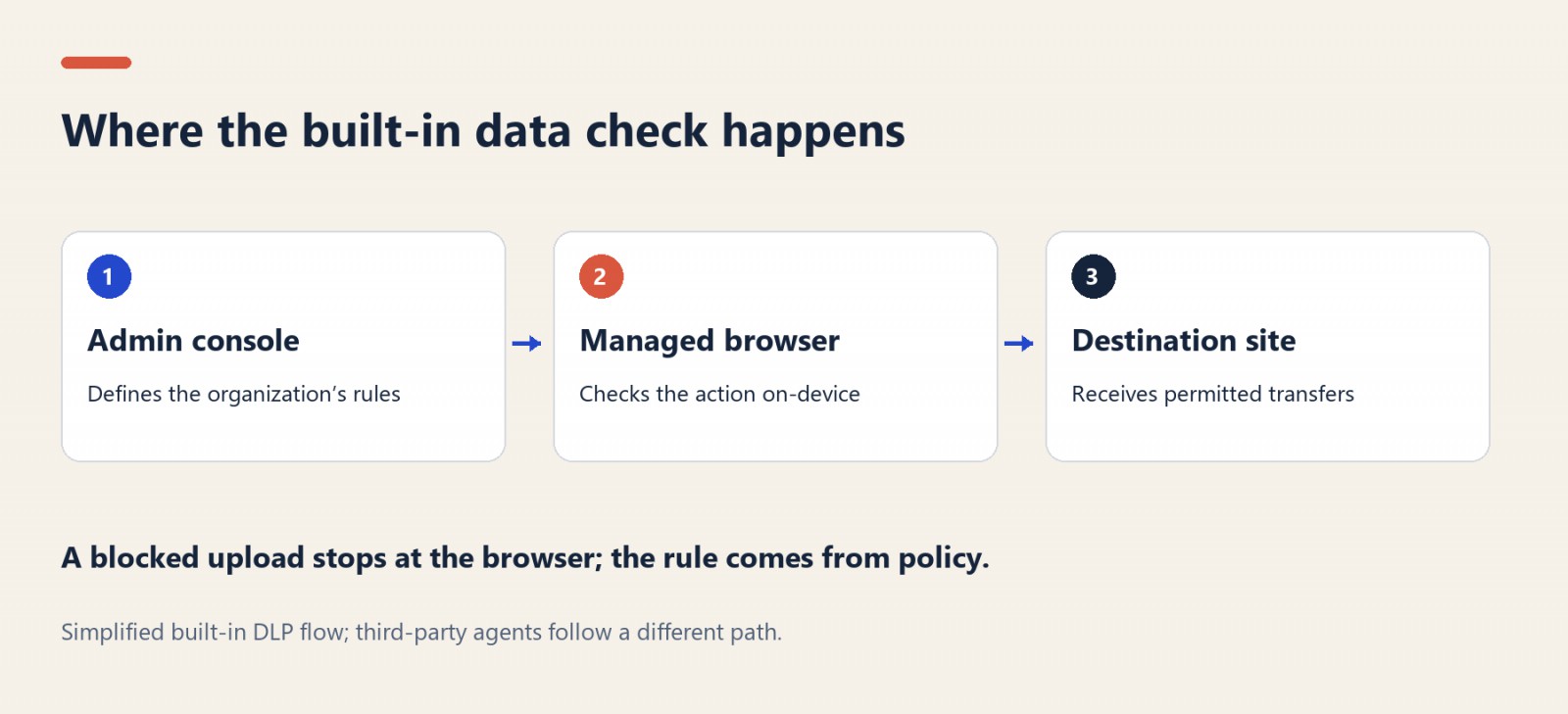
Firefox Enterprise can govern actions such as pasting, uploading and downloading on selected sites. Its documented built-in data-loss-prevention checks run on the device. An organization with a supported external content-analysis agent can instead defer to that agent.
That places a policy decision close to the action that moves information. A file upload to an unapproved AI service can be stopped before the transfer completes, rather than merely appearing later in an audit. But the rule still needs an accurate scope. A restriction that blocks legitimate work may encourage employees to find a different route, while an overly broad exception can defeat the intended control.
The surrounding policy therefore matters as much as the toggle. Employees need to know which tools are approved, what information can be sent to them and how to request an exception. A browser can enforce a decision; it cannot resolve an unclear organizational decision by itself.
Independence and compatibility are separate tests
Firefox uses Mozilla's Gecko engine. That gives organizations a different underlying browser architecture from Chromium-based products, a point Mozilla emphasizes in its launch case. It does not guarantee that every internal web application behaves identically after a switch. Authentication flows, extensions, document tools and line-of-business applications still need representative testing.
Mozilla's earlier professional support announcement also explains the role of dedicated issue triage and escalation. Support, browser-engine choice and self-operated management are related purchasing considerations, but they are not interchangeable features.
For Italian institutions, the immediate relevance is the procurement and architecture question, with local access and contract terms still to establish. For international organizations, it is a chance to assess a browser as part of the managed infrastructure rather than as an incidental application. Our Firefox coverage also follows its public-web capabilities, including JPEG XL support. Enterprise adoption will depend on a different test: whether the extra control is worth the operational responsibility that comes with it.