
How The Mosquito Bowl brought Wisconsin’s 1940s football stadium back to the screen
A photograph, modern lidar scans and a familiar row of arched windows helped recreate Camp Randall for Peter Berg’s film, streaming November 25.
Look beyond the far end of the football field in The Mosquito Bowl and there’s a better clue to the date than any jersey. The large building with arched windows is the Wisconsin Field House. It closed off the south end of Camp Randall Stadium in 1930. For one overhead view of the ground as it looked in the 1940s, filmmaker Peter Berg’s team combined a period photograph with modern lidar scans. The result can be seen in the production still released by the University of Wisconsin–Madison.
The film arrives on Netflix on November 25, following a limited theatrical release in October. It adapts Buzz Bissinger’s nonfiction book about college football players who joined the US Marines after Pearl Harbor. There are two places worth distinguishing before watching. Camp Randall is where some of these men played for rival universities. The Mosquito Bowl itself was a different game, played on Guadalcanal on Christmas Eve, 1944.
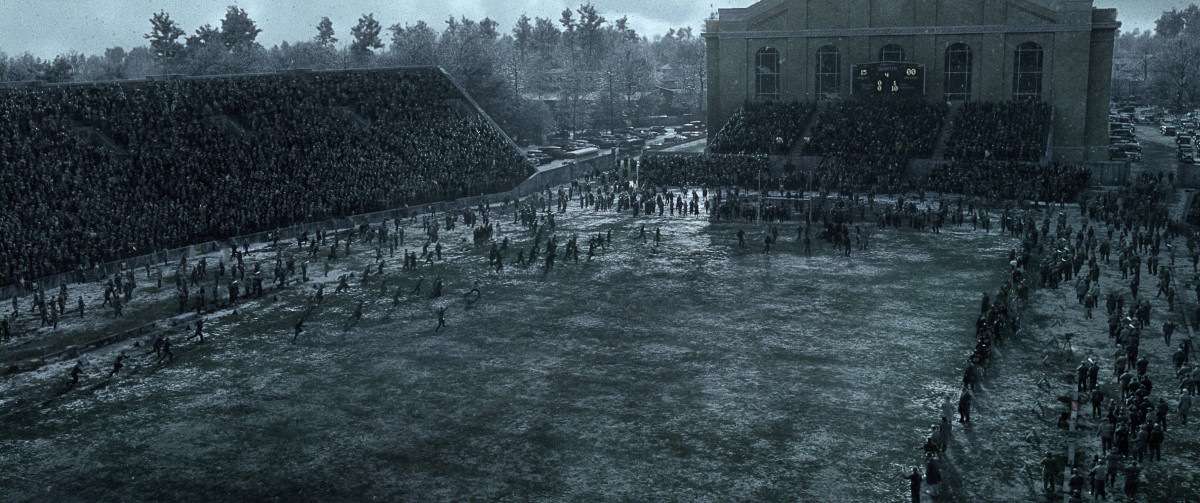
A photograph can tell you what the scanner can’t
Even an empty stadium changes. According to Wisconsin’s history of Camp Randall, an expansion begun in November 1939 put 7,500 more seats on the east side. Below those spectators was something a camera at midfield would struggle to show: a dormitory. The university was short of housing. What happened to the stands depended partly on what Madison needed outside football.
That history explains why the date on the reference photograph matters. Lidar measures distances with pulses of light. A modern scan can fix the position and dimensions of surviving structures. It can’t say which seats were there eighty years ago. A period image can supply that missing outline, but a single view gives little information about whatever was behind the photographer. The two records answer different questions about the same patch of ground.
For a comparison you can make before seeing the film, the Wisconsin Historical Society has a 1930 view from the stands. Look towards the Field House in that photograph, then look at the far end of the film still. It’s a way to get your bearings across two very different pictures. The Society’s photograph predates the east-side expansion by nearly a decade.
The players who knew the place
Two of the film’s four players would have recognized the stadium as home. Tom Francis plays Wisconsin’s Dave Schreiner and Bill Skarsgård plays his teammate Bob Bauman. Ray Nicholson plays Tony Butkovich of Purdue, while Nicholas Galitzine plays John McLaughry of Brown. The names on those jerseys had meaning before the men joined the Marines. Players who represented different universities would find themselves carrying a shared game into the Pacific.
Berg previously took Bissinger’s Friday Night Lights from page to screen. That book followed a high-school team in Texas. This time the filmmaker can start with a crowd, uniforms and a purpose-built stadium, then ask what remains of the sport when almost all that equipment falls away. The Guadalcanal players had a ball and willing opponents. Their field had pieces of coral underfoot.
Berg also discussed his approach to the planned Call of Duty film while promoting this one. Here he had a more specific obligation than capturing the atmosphere of a period: people still live in the city where these players once drew a crowd. You can check his Wisconsin skyline against theirs, right down to the windows behind the end zone.